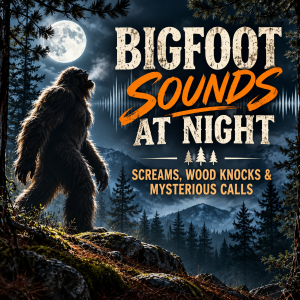
Imagine camping deep in the forest. The campfire is fading, the trees are completely still, and somewhere in the darkness, a long, haunting scream echoes across the mountains.
It doesn’t sound quite human. But it doesn’t sound like any animal you recognize, either.
Could it be Bigfoot?
For decades, people have reported strange Bigfoot sounds at night, from terrifying screams and deep howls to rhythmic wood knocks and unusual vocalizations. Some witnesses believe these noises are evidence of Sasquatch communicating in the wilderness.
But what do these mysterious sounds actually tell us?
What Does Bigfoot Supposedly Sound Like?
Unlike familiar animals such as coyotes, owls, or mountain lions, Bigfoot has no scientifically established vocalization.
Instead, descriptions come from eyewitness accounts, recordings, and stories passed down through generations.
Reported sounds include:
- Long, powerful screams that seem to carry for miles
- Deep, guttural howls unlike ordinary wolf calls
- Repeated knocking sounds resembling wood striking wood
- Strange whistles, whoops, and short calls
- Low growls or rumbling noises
- What witnesses describe as chattering or unintelligible speech
Although these reports are fascinating, no sound recording has been scientifically confirmed as coming from Bigfoot.
That uncertainty is part of what makes the mystery so compelling.
The Famous Sierra Sounds Recordings
One of the most discussed examples of alleged Bigfoot vocalizations comes from recordings made in California’s Sierra Nevada mountains during the 1970s.
Often called the Sierra Sounds, the recordings are associated with Ron Morehead and Al Berry, who reported hearing unusual vocalizations during wilderness expeditions.
The recordings contain a remarkable mixture of whoops, whistles, growls, and speech-like sounds.
Some Bigfoot enthusiasts believe the recordings capture communication between unknown primates.
Skeptics point out that unusual audio alone cannot establish the existence of an unidentified species. Without a verified source, the recordings remain open to interpretation.
Nevertheless, the Sierra Sounds have become an enduring part of Sasquatch folklore.
Bigfoot Wood Knocks: Communication or Coincidence?
Another frequently reported phenomenon is the mysterious wood knock.
Imagine hearing three loud knocks from somewhere beyond your campsite.
You wait.
A few moments later, another knock comes from a different direction.
Bigfoot researchers and enthusiasts sometimes interpret these sounds as possible communication between creatures.
Some even attempt to reproduce the noises by striking trees with sticks, hoping for a response.
But there are other possible explanations.
Branches can strike trunks in windy conditions. Falling limbs, shifting trees, and ordinary human activity can also produce sharp knocking sounds.
Without seeing what caused the noise, determining its source can be extremely difficult.
Still, reports of repeated knocks continue to intrigue people who investigate the Bigfoot mystery.
Could Wildlife Explain Bigfoot Sounds at Night?
Here’s where things get especially interesting.
Some perfectly ordinary animals can produce sounds that are downright terrifying when heard in the dark.
Mountain Lions
Mountain lions can produce piercing screams that sound surprisingly human.
A person unfamiliar with these calls might imagine something enormous and frightening lurking nearby.
Foxes
Certain fox vocalizations resemble screams, shrieks, or distressed cries.
In the right setting, they can sound almost supernatural.
Coyotes
Coyotes communicate through howls, yips, barks, and group vocalizations.
Several coyotes calling together can create the impression of a much larger gathering.
Owls
Some owl species produce deep hoots, eerie screams, and other unexpected calls.
Their sounds can carry through quiet forests, especially at night.
Elk
During mating season, bull elk produce distinctive bugling calls that can include high-pitched whistles and deep grunts.
To someone hearing one for the first time, the sound can be startling.
These animals demonstrate why an unidentified sound isn’t necessarily evidence of an unidentified creature.
But they also help explain why mysterious forest noises have inspired so many stories.
Why Do Strange Forest Sounds Seem Scarier at Night?
Darkness changes how we experience the world.
When visibility disappears, hearing becomes one of our primary ways of understanding our surroundings.
An unfamiliar sound can trigger an immediate sense of danger, even when its source is harmless.
Forests also create unusual acoustic effects.
Sound may travel across valleys, reflect from rocky slopes, or become distorted by vegetation and terrain.
Distance can be especially difficult to judge.
Something relatively small and nearby might sound enormous. A distant animal might seem much closer than it actually is.
Add a little imagination, a lifetime of Bigfoot stories, and a remote mountain setting, and an ordinary noise can become an unforgettable experience.
Have Bigfoot Sounds Ever Been Proven Real?
People have collected numerous recordings of alleged Bigfoot screams, calls, and wood knocks.
However, none has established the existence of Sasquatch through independently verified scientific evidence.
Audio recordings can be difficult to evaluate because they often lack clear information about the sound’s source.
Even an unusual recording that doesn’t immediately match a known animal cannot, by itself, demonstrate that an unknown primate produced it.
For investigators, stronger evidence would include a reliably documented source, corroborating physical evidence, and independent verification.
Until then, alleged Bigfoot sounds remain an intriguing collection of reports rather than confirmed biological evidence.
What Should You Do If You Hear Something Strange in the Woods?
If you hear an unfamiliar scream, howl, or knocking sound while camping, curiosity is understandable.
But safety should come first.
Stay near your campsite or companions, avoid approaching unknown wildlife, and never wander into unfamiliar terrain at night simply to investigate a noise.
If you can safely record the sound, note the time, location, weather, and direction it came from.
Those details may help identify its source later.
And remember: a mysterious sound doesn’t necessarily mean something mysterious made it.
The Mystery of Bigfoot Sounds at Night Continues
There’s something undeniably captivating about the idea of an enormous, undiscovered creature calling through the wilderness.
Perhaps that’s why stories about Bigfoot sounds at night have endured for generations.
Are witnesses hearing familiar animals in unfamiliar circumstances? Are some recordings deliberate hoaxes? Or could there still be natural phenomena we haven’t fully identified?
For now, the evidence doesn’t establish Bigfoot as the source of these sounds.
But the stories continue to capture our imagination.
And the next time you’re sitting around a campfire and a strange howl echoes through the trees, you might find yourself wondering what’s out there.
What about you? Have you ever heard a strange sound in the woods that you couldn’t explain? Share your experience in the comments.
Explore More Bigfoot Mysteries
Curious about Sasquatch? Explore our other MadTymes articles about Bigfoot sightings, mysterious footprints, and the enduring debate over whether Bigfoot exists.
And if you love cryptid legends as much as we do, browse our Bigfoot-inspired shirts, ornaments, and gifts at MadTymes.com.

Merry Squatchmas Ornament – Bigfoot Cabin Christmas

Santa Bigfoot Christmas Ornament – Busting Through

Bigfoot Christmas Ornament – Christmas Takes All Kinds

Less People More Pines Shirt – Bigfoot Comfort Colors Tee

Cryptid Christmas Ornament – Believe in Miracles

Bigfoot Sasquatch Graphic Tee | Happier Off the Beaten Path

Happier Off the Beaten Path Bigfoot Sasquatch Tote Bag

Personalized Bigfoot Trucker Hat – Sasquatch Field Research Patch

Bigfoot Beanie – Camo Sasquatch Patch Hat

Mindspeak Bigfoot Beanie – Camo Cryptid Hat

Bigfoot National Park Sweatshirt

Bigfoot Social Distancing Mug – 15 oz

Adventure Is Out There Bigfoot Mug – 15 oz

Bigfoot Adventure Mug – 15 oz