

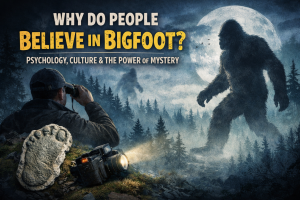
For decades, Bigfoot has walked the blurry line between myth and possibility.
But an even more interesting question might be this:
Why do people believe in Bigfoot in the first place?
Despite the lack of confirmed scientific evidence, belief in Sasquatch remains widespread. Thousands of eyewitness reports, documentaries, and organized research efforts continue to fuel curiosity about the legendary creature.
So what drives this belief?
The answer lies in psychology, culture, history, and the deep human attraction to mystery.
The Power of the Unknown
Humans are naturally drawn to mysteries.
From ancient myths to modern unexplained phenomena, stories about the unknown capture imagination in a way few things can. Bigfoot represents something rare in today’s world: the possibility that something undiscovered still exists.
In an age where satellites map the planet and smartphones document nearly everything, the idea that a large, unknown creature could roam remote forests feels both improbable and strangely comforting.
Mystery invites curiosity. And curiosity sustains belief.
Pattern Recognition and Human Perception
The human brain is wired to detect patterns.
Evolutionarily, this trait helped our ancestors survive. If early humans mistook a shadow for a predator, it was safer to react than to ignore it.
Today, that same instinct can influence how people interpret ambiguous sights and sounds.
A distant shape in the trees.
Large footprints in mud.
Unfamiliar calls echoing through the forest.
For someone familiar with Bigfoot stories, the brain may quickly connect those details to a known legend.
This doesn’t automatically mean sightings are fabricated. But it does highlight how perception works when expectations and prior knowledge are involved.
The Role of Cultural Reinforcement
Bigfoot is no longer just a regional legend.
It has become embedded in popular culture through:
- Television documentaries
- Podcasts
- YouTube investigations
- Books and research organizations
One of the most well-known groups documenting sightings is the Bigfoot Field Researchers Organization (BFRO), which maintains a public database of reported encounters across North America:
https://www.bfro.net/
When stories are shared widely and repeatedly, they become part of cultural awareness. Communities form around shared curiosity, and belief can strengthen through discussion and collective exploration.
The legend evolves from isolated stories into a cultural movement.
Consistency in Eyewitness Reports
One reason belief persists is the consistency in reported sightings.
Many eyewitnesses describe similar features:
- Height between 7 and 9 feet
- Dark brown or black hair
- Broad shoulders and muscular build
- Long, powerful strides
- A strong, musky odor
- Large human-like footprints
These similarities raise interesting questions. Are independent witnesses describing the same type of experience? Or are cultural narratives shaping memory and interpretation?
Research into eyewitness testimony shows that memory can be influenced by suggestion and expectation, a topic widely discussed in cognitive psychology:
https://www.simplypsychology.org/eyewitness-testimony.html
Yet even with those considerations, the sheer volume of reports continues to intrigue both believers and skeptics.
The Patterson-Gimlin Film and Lasting Impact
The most famous piece of alleged Bigfoot evidence is the 1967 Patterson-Gimlin film, recorded in Northern California.
The footage shows a large, upright figure walking along a creek bed before briefly turning toward the camera.
Supporters argue that the creature’s gait and muscle movement appear realistic. Skeptics maintain it was a costume or hoax.
Decades later, the clip continues to spark debate and analysis. The Smithsonian Magazine has examined the cultural and scientific controversy surrounding the footage:
https://www.smithsonianmag.com/history/bigfoot-evidence-hoax-or-real-180977733/
The endurance of this single piece of footage demonstrates how powerful one unresolved image can be in shaping long-term belief.
The Appeal of the Undiscovered
Throughout history, humans have been fascinated by the possibility of undiscovered species.
New animals are still identified every year, particularly in remote environments. The National Geographic Society regularly documents newly discovered species worldwide:
https://www.nationalgeographic.com/animals/article/new-species
While no undiscovered North American primate has been verified, the existence of ongoing biological discoveries helps keep the possibility alive in some minds.
Bigfoot represents wilderness. Untamed landscapes. The idea that nature still holds secrets beyond human control.
For many, that idea alone is compelling.
Skepticism and Scientific Standards
Most scientists remain unconvinced by Bigfoot claims.
The primary arguments against the creature’s existence include:
- No verified DNA evidence
- No confirmed skeletal remains
- No clear, modern photographic proof
- No fossil record supporting a large primate species in North America
In science, extraordinary claims require extraordinary evidence — a principle famously associated with Carl Sagan:
https://www.brainyquote.com/quotes/carl_sagan_133929
Without verifiable biological data, the scientific community generally attributes sightings to misidentification, hoaxes, or psychological factors.
Yet the absence of proof does not entirely eliminate public fascination.
Bigfoot as Modern Folklore
Legends of wild, human-like creatures appear in cultures around the world.
The Yeti in the Himalayas.
The Yowie in Australia.
The Orang Pendek in Indonesia.
Anthropologists often view Bigfoot as part of a broader tradition of folklore tied to wilderness and cultural storytelling.
The University of British Columbia has explored the Indigenous origins of the Sasquatch legend, tracing it back to oral histories long before modern media:
https://indigenousfoundations.arts.ubc.ca/
Modern technology has not erased folklore. Instead, it has amplified it.
Online communities, podcasts, and social media allow legends to spread faster than ever.
Why the Legend Endures
Belief in Bigfoot persists because it satisfies something deeper than simple curiosity.
It touches on:
- The desire for mystery
- The thrill of exploration
- Community belonging
- The appeal of the unexplained
For some, belief is literal. For others, it is symbolic — a way to keep wonder alive in an increasingly documented world.
Even skeptics often admit that the mystery itself is entertaining.
And until definitive proof confirms or disproves its existence, Bigfoot remains suspended between myth and possibility.
Final Thoughts
So why do people believe in Bigfoot?
Because mystery is powerful.
Because shared stories build community.
Because humans are wired to search for meaning in the unknown.
And because the idea that something extraordinary might still roam the forests of North America is too intriguing to fully dismiss.
Whether Bigfoot is biological reality or enduring folklore, one thing is certain:
The legend is not going away anytime soon.
If you’re still weighing the evidence, explore our deeper breakdown of the ongoing debate in Is Bigfoot Real? Evidence, Skeptics & The Ongoing Debate, where we examine the most famous sightings, footprint casts, and scientific arguments on both sides.
For many fans of Sasquatch lore, curiosity doesn’t stop at documentaries and sightings. Cryptid culture has grown into a way for believers to express personality — from artwork and collectibles to novelty pieces inspired by the legend itself. If you lean toward the believer side of the debate, you might enjoy our Believe in Bigfoot license plate, designed for those who proudly keep the mystery alive.